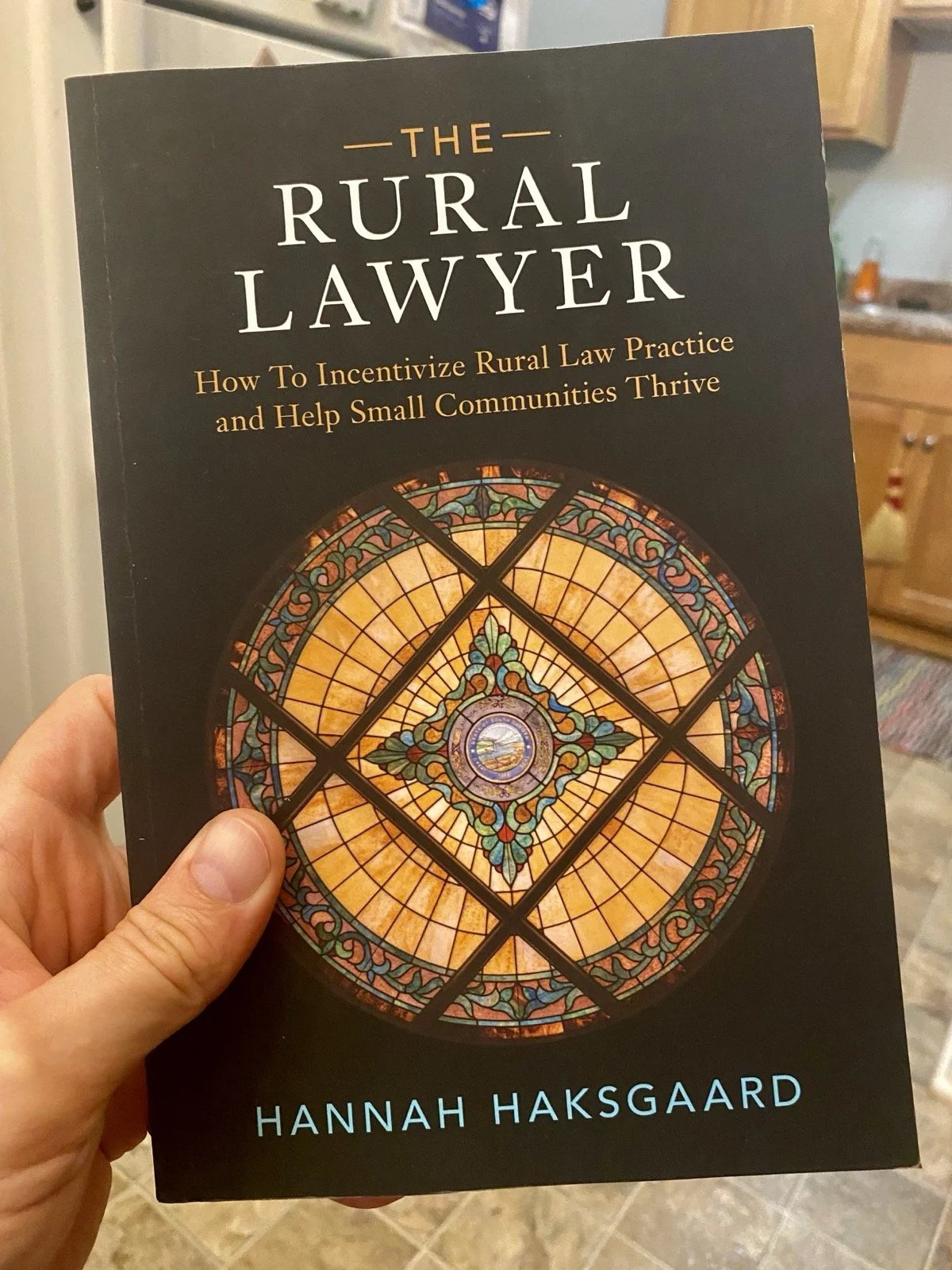
I finished a great book, The Rural Lawyer: How to Incentivize Rural Law Practice and Help Small Communities Thrive by Hannah Haksgaard. This is a book I would recommend to rural practitioners, policy makers, and people who love rural places.
The Rural Lawyer reminded me of an expression I’ve heard in West Virginia and Kentucky, “in some counties there are only two lawyers, the judge and the prosecutor.” It is no secret that rural communities across the United States are grappling with a severe population decline, brain drain, and the silver tsunami. Rural lawyers do more than address the justice gap by providing legal services, they also help communities thrive. As Haksgaard observes, “without access to legal services, businesses may not form, estate plans may not be written, and communities may wither.”
In her book, Haksgaard takes an unflinching look at the South Dakota Rural Attorney Recruitment Program and the challenges rural America faces attracting and keeping lawyers. The South Dakota program, created in 2013, pairs new lawyers with rural communities and provides participating lawyers with a yearly stipend for a period of five years. This financial support acts as an incentive and support to establish these new lawyers in rural communities. Haksgaard examines the success and shortcomings of the program by speaking directly to program participants and all other people involved in the program. The Rural Lawyer digs deeper than asking, “are these people making money?” But The Rural Lawyer asks, “Are these people making a difference?” “Are they happy?” “Are accepted by the community they’ve chosen to practice law in?”
A big strength of The Rural Lawyer is the very human approach to the data. With a small sample size of thirty-two participants, the author was able to really spend time with these people and see what worked for them and what didn’t work for them. But each story was fascinating. Some participants simply showed up on Main St, hung up a shingle, and started to take criminal appointments. Some participants had support from the community, a senior local lawyer employed them at their law practice and gave them administrative support. My favorite was Dusty Ginsbach, a part time lawyer/ part time oil field worker in a county with 1,178 residents spread over 2,671 square miles. The largest town where he practices has 349 people. The author brings these stories alive and pairs it with data about rural communities.
The big surprise reading this book is how dramatic a change having a new lawyer practice in a town helps so many people. Haksgaard spends a persuasive amount of time on the savings local governments receive by having a lawyer so close. She does a great job of explaining that paying a lawyer to set up shop will save the county money on paying lawyers to travel to your courthouse or city hall to provide services. On the other side of the coin, she also explains the simple fact that these are new tax paying citizens who like to volunteer and do pro bono work. Haksgaard also gives equal shift to criminal and civil practice and the impacts these lawyers have. When you don’t have lawyers to prosecute a case, defend the accused, write up an estate plan, and help transfer property, the costs really add up.
While a well-executed piece of academia endorsing the rural lawyer program, The Rural Lawyer fell short in a way that should be a clarion call to the people who study and love rural communities. There were not enough studies on rural communities and rural lawyers to compare to. Haksgaard faithfully explained the other policy responses, judicare, public defenders, and legal aid. But the big studies used in The Rural Lawyer were from Australia, and understandably, South Dakota. So, any researchers reading this, please talk to rural people in West Virginia and Kentucky. There is a lot we can learn from The Rural Lawyer that would apply to the Appalachian idiom, and Haksgaard does not ignore this, but there simply isn’t enough research on the rural justice gap in these areas to pull from.
The Rural Lawyer resonated with my experience, growing up in West Virginia and practicing law in Kentucky and I think it is a must read for Law School professors running law clinics, public interest lawyers, and bar leaders. The issues the young lawyers face in the South Dakota program are the same issues I and many of my law school cohort faced. How can we practice law in the communities we love, make a living, and have a full life? Rural communities are in crisis. Young people are fleeing their small towns for cities. This is a major problem for West Virginia and Kentucky. That is why I think Haksgaard’s examination of the South Dakota program is so important to read.